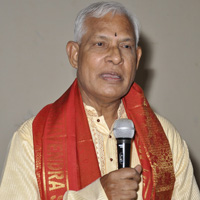
Nallan Chakravarthy Murthy is a distinguished scientist-musician, vaggeyakara (singer-composer), and guru who has made extraordinary contributions to Carnatic music through his scientific approach to composition and research. A former Deputy Director of CSIR-Indian Institute of Chemical Technology (IICT), Hyderabad, and Former Professor at MS University, Baroda, he may have been a chemical engineer by profession, but he is today better known for his monumental literary and compositional contributions to Carnatic music. His scientific background has uniquely positioned him to extend the boundaries of knowledge in classical music through systematic research and innovative compositions.
Early Life and Musical Foundation
Growing up in Hyderabad during the 1940s, Chakravarthy enjoyed music without being burdened by expectations. As a teenager singing light music and film songs, he was spellbound listening to legendary musicians like Bade Ghulam Ali Khan and later Mangalampalli Balamuralikrishna in concert. This exposure to greatness led him to become a disciple of the renowned Nookala Chinna Satyanarayana to learn Carnatic music, establishing his foundation in the classical tradition.
Scientific Career and Musical Integration
Chakravarthy retired in 2000 as Deputy Director at CSIR-Indian Institute of Chemical Technology, Hyderabad, after a distinguished career in chemical engineering. He admits that being a scientist significantly aided his approach to research and extending boundaries of knowledge in Carnatic music. His scientific methodology has enabled him to pursue a relentless exploration of musical possibilities that continues even in his eighties.
Monumental Compositional Achievement
His magnum opus, "Apoorvaraga Krithimanjari," documents 100 new compositions in ragas hitherto unattempted by any earlier Vaggeyakaras. This extraordinary work covers all 72 Melakarthas, a gigantic task he fulfilled in just five months. The veteran Vaggeyakara and revered guru Mahamahopadhyaya Kollegal R. Subramanyam, who wrote the foreword, praised Murthy for his effort in researching rarely attempted ragas with due rhythmical lyrics.
Prolific Literary Contributions
Chakravarthy has authored 15 books to date, encompassing myriad facets of Carnatic music. His publications include:
- Janaka Raga Varna Manjari - Tana varnams in 72 melakarta ragas (2007)
- Ghana Raga Varna Panchakam - Padavarnams in ghana ragas
- Devi Murthy Nava Sudha Deepti
- Navya Tana Varnamulu
- Dwadasa Tillana Mala
- Nutana Sata Keertana Swaravali
- Apurva Raga Kriti Manjari
- Navanavya Padams
- Bhajeham Ganesham
- Pracheena Raga Kriti Manjari
- Raganga Raga Kriti Manjari
- Bhava Raga Tala Varna Manjari
- Chaturdasa Thillanamala
- Vivadi Raga Sarala Keertana Manjari
Comprehensive Musical Compositions
His compositional output includes over 1,000 novel compositions in kirtanas, thillanas, and padams. He has created Tana varnams in all 72 melakartas and padavarnams in ghana ragas, which were reviewed by Mangalampalli Balamuralikrishna himself. His works include Varnams that help singers evolve faster, Tillanas in Swaraantara ragas containing only four swaras, and compositions using rare ragas. He is also adept in light music with over 500 pieces in Telugu, Kannada, and Hindi.
Teaching Philosophy and Methodology
As a guru who now conducts virtual classes, Chakravarthy's approach to music emphasizes "ease of learning without sacrificing the sastra and technicalities to emphasize bhava." His focus is on clarity and the importance of expression. He advocates that sensitivity and bhavam in expression make singing soulful rather than mechanical. His three-step formula for learners is: Explore, Experience, and Internalize, which he believes works for learning the nuances of any subject.
Daily Practice and Spiritual Discipline
An early riser, Chakravarthy follows a disciplined routine of taking a bath by 4 AM and dedicating two hours during Brahma muhurta for musical exploration. He considers this a class conducted by the divine, using this time exclusively to research new ragas or create compositions rather than practicing existing music. This systematic approach reflects his scientific temperament applied to spiritual and artistic pursuits.
Cultural Contributions and Collaborations
He has made significant contributions to cultural presentations, including singing for Simhanandini (where the dancer draws the figure of a lion with the feet) when his father-in-law and Kuchipudi dancer C.R. Acharya presented it for the first time at Shanmukhananda Auditorium in Mumbai in 1968. This demonstrates his versatility and willingness to contribute to interdisciplinary artistic endeavors.
Personal Life and Support System
His wife N.C. Lakshmi has been a pillar of support throughout his musical journey. Currently residing in Mumbai, he maintains strong connections with Hyderabad through his daughter Suvarna. His family's support has been crucial in enabling his extensive research and compositional work.
Modern Outreach and Technology Adoption
Despite his advanced age, Chakravarthy actively shares his knowledge on social media, hoping to inspire youngsters in the field. He has embraced virtual teaching methods, demonstrating his adaptability to modern technology while maintaining traditional values in music education.
Current Projects and Future Vision
Among his current plans are publishing a book on Thillanas and recording more than 100 new compositions. However, he acknowledges that his age limits his ability to travel to recording studios in Mumbai, and he is actively looking for a disciple who can continue his pursuit of expanding Carnatic music's boundaries.
Spiritual and Philosophical Approach
When his mind becomes blank, he listens to his "maanaseeya guru" (mental guru), Mangalampalli Balamuralikrishna, and follows his three-step formula to rejuvenate. This demonstrates his humility and continuous learning attitude despite his own significant achievements.
Legacy and Continuing Impact
Nallan Chakravarthy Murthy represents a unique synthesis of scientific rigor and artistic creativity in Carnatic music. His systematic approach to exploring uncharted musical territories, combined with his prolific compositional output and educational contributions, has significantly enriched the Carnatic music repertoire. Through his 15 books and over 1,000 compositions, he has provided future generations with a vast treasure trove of musical knowledge. His work exemplifies how a scientific mindset can enhance rather than diminish artistic expression, opening new possibilities for musical exploration while maintaining deep respect for traditional foundations. His continuing efforts to find disciples to carry forward his work ensure that his innovative approach to Carnatic music research will inspire future generations of musicians and scholars.