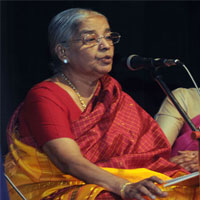
Vidushi Alamelu Mani (born 4 October 1934) is a distinguished Carnatic vocalist, educator, and one of the most respected music teachers in Mumbai. Renowned for her staunch classicism and deep knowledge of traditional repertoire, she has been a pillar of Carnatic music in Mumbai for over six decades. As the longtime Principal of the South Indian School of Music since 1963 and mother of celebrated singer Hariharan, she represents a unique bridge between the golden era of Carnatic music and contemporary practice. Her dedication to preserving and teaching classical music has earned her national recognition, including the prestigious Sangeet Natak Akademi Award in 2018.
Early Life and Musical Foundation
Born on 4 October 1934 in Mumbai into a household where the arts were revered, Alamelu was naturally drawn to music from childhood. Her father, Varadhan, played the harmonium for Tamil dramas staged in Mumbai, which brought renowned musicians like Maharajapuram Vishwanatha Iyer and Papa Venkatramaiah to their home. This early exposure to great artists, along with her sister Janaki, provided her with an exceptional foundation in ragas and kritis from a young age.
Training and Early Musical Development
At age 10, Alamelu and her sister Janaki were placed under the tutelage of H.A.S. Mani, who was running the South Indian School of Music and had trained many students including the Bombay Sisters. Under his strict guidance, both sisters blossomed as musicians. Mani was known as a taskmaster whose rigorous training methods produced excellent results.
Marriage and Personal Life
In an unexpected turn of events, her guru H.A.S. Mani proposed marriage to the 19-year-old Alamelu in 1954. Initially shocked and refusing what she called "one-sided love," she eventually accepted after he sought her parents' approval. The marriage to her guru, who was 12 years her senior, was blessed by her father. Their son Hariharan was born a year later in 1955, completing their family.
Early Career and Recognition
Around the time of her marriage, All India Radio announced its first-ever music competition. Alamelu was among 45 chosen vocalists and, despite being nervous performing before legendary judges including Mudicondan Venkatarama Iyer, Musiri Subrahmanya Iyer, Dwaram Venkataswamy Naidu, and Dandayudhapani Pillai, she won the Gold Medal. She performed a Ragam Tanam Pallavi in Pantuvarali with the kriti "Paripalaya" and later received her award from President Rajendra Prasad in Delhi.
Tragedy and Resilience
By 1960, Alamelu had presented several concerts on AIR and other venues in Mumbai and had recorded albums. However, tragedy struck in 1963 when her husband Mani suddenly passed away, leaving her widowed at just 28 with an 8-year-old son. Despite this devastating loss, she found solace in music and decided to become a full-time Carnatic teacher.
Training under T. Brinda
In 1964, a year after her husband's death, Alamelu met the legendary T. Brinda (Brindamma) through Aruna Sairam's mother. This meeting proved therapeutic and transformative. Brinda, who belonged to the illustrious devadasi lineage (Veena Dhanammal was her grandmother and Balasaraswati her cousin), taught Alamelu many padams and javalis during her annual month-long visits to Mumbai. Over ten trips, Brinda imparted invaluable knowledge and became a healing presence in Alamelu's life.
Additional Musical Influences
Beyond T. Brinda, Alamelu also learned from other masters including Thanjavur V. Sankara Iyer and received guidance from Semmangudi Srinivasa Iyer during her visits to Chennai. These great musicians taught her not just music but also how to respect and appreciate other artists and imbibe something from everybody.
Educational Leadership
Since 1963, Alamelu has served as Principal of the South Indian School of Music in Mumbai, a position she has held for over six decades. She was also the first head of the Shanmukhananda Music School, Mumbai. Her commitment to staying in Mumbai, despite opportunities to move south, was driven by her dedication to her son's education and musical development.
Teaching Legacy and Philosophy
Over her 50+ year teaching career, Alamelu has trained over 1,000 students from all over the globe. She believes this extensive teaching is her life's mission. Her approach emphasizes both technical excellence and the spiritual aspects of music, following the example set by her illustrious gurus who taught her to find meaning beyond mere performance.
Repertoire and Musical Knowledge
Alamelu possesses an amazing repertoire of songs, particularly rare compositions learned from T. Brinda and other masters. Her knowledge includes traditional padams, javalis, and classical kritis that she shares with her students. She appreciates masters such as M.D. Ramanathan, G.N. Balasubramaniam, Madurai Mani Iyer, 'Flute' Mali, and Ramnad Krishnan.
Awards and Recognition
Her contributions to Carnatic music have been recognized with several prestigious honors:
- Sangeet Natak Akademi Award (2018) - National recognition for excellence in Carnatic music
- Dronacharya Award - From The Rotary Club of Madras East for her teaching excellence
- Gold Medal - AIR's first music competition
Relationship with Son Hariharan
Alamelu shares a close bond with her son Hariharan, who lost his father at an early age. Their relationship extends beyond the personal to the musical - they communicate through ragas during travels, with one beginning a raga alapana and the other improvising. While she doesn't listen to all his film songs, she appreciates his ghazals and his connection to Hindustani music.
Musical Family Legacy
The musical tradition continues with her two grandsons, who have inherited strong musical sensibilities. This multi-generational involvement in music reflects the deep-rooted musical culture that Alamelu has fostered in her family.
Contribution to Mumbai's Musical Culture
As one of the last representatives of a lost world of Carnatic music in Mumbai, Alamelu has played a crucial role in maintaining the city's classical music traditions. During her early years, Mumbai had a strong Carnatic base with many stalwarts performing regularly, providing ample opportunities for classical music practice and appreciation.
Performance with T. Brinda
One of the highlights of her career was performing with her idol T. Brinda in 1992, a moment that represented the culmination of their guru-shishya relationship and her artistic journey.
Philosophy and Approach
Despite the sacrifices she made, including staying in Mumbai when she could have moved to Chennai's more vibrant Carnatic music scene, Alamelu has no regrets. She believes in living life on her own terms while serving the cause of classical music. Her approach to music emphasizes both technical mastery and emotional depth, reflecting the teachings of her various gurus.
Continuing Legacy
Now in her nineties, Alamelu Mani continues to teach and inspire new generations of musicians. Her life represents the dedication required to preserve classical traditions while adapting to changing circumstances. Through her teaching, she ensures that the knowledge and repertoire she learned from legendary masters like T. Brinda continue to be transmitted to future generations. Her story exemplifies how personal resilience, combined with artistic dedication, can create a lasting impact on cultural preservation and musical education. As one of the few remaining links to the golden era of Carnatic music, her contributions extend far beyond her individual achievements to encompass the preservation of an entire musical tradition in Mumbai.